Showing posts with label art. Show all posts

Tuesday, December 9, 2008

Release The Comic Strip Creator

I have a severe lack of skill when it comes to drawing despite a life long love of art and comic books. As a child I checked out the instructional drawing books such as the Marvel comics book to the left from my library hoping to recreate the superheroes, animals and crazy cars created through guided steps. My results usually lacked the finished touches of the book examples but I kept on trying into my teenage years. Now, the internet and a host of comic creating websites have alleviated my lack of drawing prowess with ready made drawings, panels, word bubbles, fonts, and other assorted features that allow the most artistically disadvantaged among us to create our own comic strip creations. Below I have alphabetically listed six of the most dependable sites along with some personal observations regarding their pros and cons. The fifth and sixth sites listed below are my favorites.

Comic Life features an easy to use interface with tons of really cool page templates featuring every possible page configuration you can imagine. Once the page templates are chosen, images from your computer or an image sharing site such as Flickr can be uploaded along with varying modifications including word balloons, fonts and colors. The program does not come with ready made cartoon drawings so any artwork would have to be uploaded from your computer. Your final creation can be saved, printed and shared with an online community. The program also requires a sign up fee ($24.95) but does allow for a 30 day free trial period. Final verdict - I love the templates but the lack of ready made art to manipulate limits what you can do. This would be my third or fourth choice from the list.

Comiqs has a very simple interface and features limited editing in comparison to the other comic creators. Images from your computer or sites such as Flickr are uploaded and added to a choice of ten different templates with varying comic strip panel layouts. Word balloons and graphics can then be added to the comic panels from a limited selection. Comiqs is free and only requires a login to share your creations. Comics you create can be shared with an online community, printed, or saved to your computer. Final verdict - Comiqs is fine for adding captions to an image but the lack of editing tools in comparison to other online comic creators really disappoints.

MakeBeliefsComix is great for anyone who wants a selection of already created drawings to manipulate. The drawings include fifteen different characters rendered from the shoulders up. Multiple characters can be added to a panel and adjusted to change their expressions, position and scale. Users also have the ability to change background colors, add various word balloons, change panel prompts and panel layouts. MakeBeliefsComic is free and features a wonderful repository of ideas. Completed comic strips can be printed or emailed. Final verdict - This is a fun and very simple program that would benefit from a little more versatility in the scope and range of already created character drawings.

Pixton includes a "quickie" and an "advanced" version with already created drawings of characters, settings and props. In the quickie version you choose a comic strip with completed art that only lacks text for the word balloons. In the next step you can add dialogue and leave everything the same or manipulate elements such as characters, background, scale, color, et cetera. The advanced version requires users to build a comic panel by panel with the same editing tools available in the quickie version. The site requires a fee but does have a free trial. Completed comics can be saved to an online forum, printed, or saved. Final verdict - The stock drawings have a somewhat generic stick figure like appearance that makes everything seem somewhat one dimensional. The site is good for creating a story with ready made drawings.

ToonDoo is probably my favorite online comic strip creator because of the range of choices presented. After creating a free account users are presented with a wide range of already created and easy to edit characters, backgrounds, props, texts, captions, et cetera to manipulate in a myriad of ways. The site also allows users to upload their own images, making this the only application wherein site generated artwork and personal images can be combined. ToonDo also features a rich collection of user content, forums, groups, and how tos. Final verdict - I wish the site had more layout templates to choose from, however, the range of editable artwork and ability to combine photos from your computer with site generated art makes this the most versatile comic creator site I have encountered.

Toonlet has the look of an Edward Gorey comic strip filled with weird site generated characters rendered in black and white. Users "build" characters from the waste up using a set of options including clothes, hair, facial expressions, et cetera, in a manner similar to a paper doll. After constructing characters users can add text and background color to their comic strips but have limited ability to change anything else. Only one character can be added per panel. Toonlet requires a free sign up to create a comic for online sharing, printing, or saving. Final verdict - I love the look of the comic strips given their Edward Gorey, Robert Crumb feel, but the limitations on editing the drawings can be annoying.

Enjoy!

How To Draw Comics The Marvel Way is a Marvel comics product and copyright

-Christopher Bishop

Monday, November 17, 2008

Retro photo fun

"rotten world" by peatle, on the Poladroid Flickr group

So I can't seem to get away from cool apps lately, lucky me. And lucky you since I feel the need to share-- I'm just nice that way!

This latest one, Poladroid, will provide you with hours of fun and add a kitchy, retro look to your Facebook photos. For those too young to remember, Polaroid cameras spat out photos instantly and you could watch the picture develop-- you can watch a video about the invention of the Polaroid here. These photos were characterized in later years by high color saturation and a white border.

Currently only available for Macs, Poladroid works like this: 1) download and launch Poladroid (it's free!), 2) drag & drop your photos, 3) look at or print your Poladroids. You can see what people have done with this app by viewing examples in the Poladroid Flickr group.
Happy editing!
Kimberley Barker

Wednesday, November 12, 2008

"A souvenir with social feedback."

The designer at the exhibit.


Designer Sebastian Campion describes himself as, "a creative concept designer with a passion for making experiential, artistic and conceptually strong design that generate new and alternative perspectives on everyday routines and situations." (http://www.guerrilla-innovation.com/about.php)

In my opinion he's certainly done that with his latest project, called "Social Souvenir", an installation piece at the Museum of Contemporary Art in Roskilde, Denmark. Campion conceptualized the exhibit of 300 black t-shirts, each printed with a quote by an artist whose work is featured in the museum, all of which are for sale. Here's the interesting part: when purchasing a t-shirt, you must agree to give your name and address. This information is then entered automatically in Google Maps, allowing the t-shirts to be traced to their new home. As the Social Souvenir website describes it: "During the course of the exhibition, the 300 T-shirts will gradually disappear from the physical museum space only to re-appear on the web."

Ok, so since I'm convinced that stalkers are lurking around every corner I could never do this... but I love the idea of it! Check out the map here.

The paranoid Kimberley Barker

Thursday, October 30, 2008

Art Reception In The CFL

Maggie Davis' art class is currently displaying their imaginative and striking work in the CFL. Westminster students, parents, faculty and staff are invited to visit on Friday (11/7/08) to participate in a reception for the artists. Pictures of the work on display are available here.

Maggie wrote the following on here new art blog concerning the project. "The 2D Design students spent the better part of October developing these larger than life imaginary characters. The idea to make such big figures evolved from the face project that Jen-Marie did with her junior high kids. I really admired the freshness of their drawings. She had them start with making a large black charcoal mark in the center of 18 x 24 paper, then she told them it was a nose and they had to create the face based on that mark. A very imaginative way to start a drawing (way to go Jen Marie). So I tried it with the 9th and 10th grade students and it was pretty amazing what they were doing. It was then I realized the drawings need to be attached to bodies and so the project evolved into something much bigger and more complicated than I imagined. To make these figures I had to get large sheets of foam core. The kids spray glued them to the foam core, then I cut the figures out and made stands for them so they would be free-standing. We put them in the high school library last week and will be having a reception for the kids on Friday (11/7/08). They are over-the-moon about their work and have been bringing their friends into the library to see their accomplishments."

- Christopher Bishop

Monday, October 13, 2008

Restructuring Words: Wordle and Concrete Poetry


I recently discovered a very fun, free and quite easy to use program called Wordle for creating word clouds. After typing in or uploading text Wordle creates a word cloud giving prominence to words that appear most in the entry. Each word is represented once in the finished product. The fun part is changing colors, font, and layout to individualize your creation. Users can upload there finished creations for others to view, print, or save to their own sites. The uses for both personal enjoyment and class lessons are limitless. I really like this classroom lesson using Wordle to dissect meaning in current event articles.

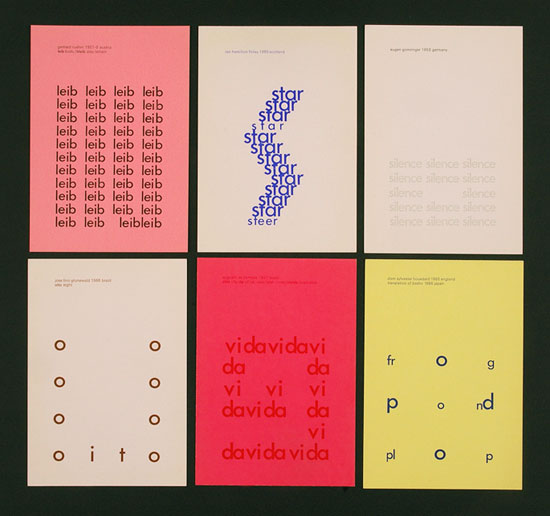
Wordle reminded me of a form of poetry I have loved since discovering the children's picture book A Poke In The I, concrete poetry. Concrete poetry, also known as pattern, shape, and visual poetry, places emphasis on the typographical structure of the written text to relate meaning even more so than the words contained in the poem. For example, a concrete poem relating the design and emotion of a sailboat will allow the words in the poem to outline and create the look of a boat. Anything and everything we see, feel, or imagine can be transformed into a shape constructed from words. The words we use to describe something become a picture in concrete poetry. For a formal definition visit Poets.org.

Concrete poetry has roots in Greek lettering and the works of authors such as Ezra Pounds, E. E. Cummings, and Lewis Carroll's description of a mouse's tale in Alice In Wonderland. The medium's modern popularization and structure comes from Europe and South America, especially Brazil where a manifesto was written to encapsulate the meaning and direction of the art form. Many of the ideas and resulting images have found their way into graphic design, advertising, and art over the years resulting in a broader understanding of concrete poetry by adherents. If concrete poetry interests you follow some of the links below and look for books online and in larger library collections.

Minimalist Concrete Poetry - A wonderful collection of images from various artists

Wikipedia entry - The article gives a brief but encompassing overview of concrete poetry

August de Campos - A leader in the Brazilian movement of the 1950s and 1960s

Concrete Poetry Creator - Site for making a concrete poem directed at children

Concrete Poems - A site with simple but fun examples


***The image above is from The Optimism of Modernity.

- Christopher Bishop

Sunday, June 29, 2008

WALL-E: Reviewed and Linked

Last night I saw the new animated film WALL-E at Atlanta's Starlite Drive-In, my favorite place to see films in Atlanta. I actually went to see Iron Man but thought WALL-E might be a cute distraction before Robert Downey Jr. turned in his surprisingly great interpretation of Tony Stark. Out of nowhere WALL-E floored me with its beautiful, sometimes almost life-like, animation while touching on questions involving the environment and the role of artificial intelligence as seen through the eyes of two robots looking for love. The love story between the film's star WALL-E, a trash receptor, and Eve, an information retrieval unit sent to earth in search of life after humans left the planet 700 years earlier due to an environmental catastrophe, is touching and surprisingly moving. However, the very overt environmental message took me by surprise. Earth is portrayed as a garbage strewn wasteland wherein only WALL-E the trash collector still exists, building skyscrapers out of condensed trash and hanging on to trinkets of the now departed human race. The emphasis on human laziness and dependency on technology to create luxury free of personal responsibility is also very overt and raises a number of questions for those who see technology as an escape from thinking and doing for oneself and those around you. The film's environmental awareness is especially timely given the current questions facing America and the world concerning use of energy sources.

The new and overt environmental awareness exhibited by mainstream Disney films such as WALL-E and conservative politicians such as John McCain seemed unlikely a few years ago, but now seems common with the advent of high gas prices and the questions raised by increasing energy costs and the realities of global warming. A film such as WALL-E serves as a fun but eye opening example of just how much America has changed in regards to environmental awareness. We are truly seeing a paradigm shift in America as the mainstream embraces the realities of environmental degradation. Hopefully the heart tugging love story shown in WALL-E will serve as a model for those who want to further reach out to skeptics through mainstream outlets.

The following books are owned by the CFL and deal in some way with issues raised by WALL-E.

The Omnivore's Dilemma: A Natural History of Four Meals
394.12 POLLAN
Pollan, Michael
An excellent examination of the food we eat, where it comes from, what it does to us, and how it effects the world we live in.

Artificial Intelligence: A Beginner's Guide
006.3 WHIT
Whitby, Blay

Earth Under Fire: How Global Warming is Changing the World
363.738 BRAAS
Braasch, Gary

-Christopher Bishop

Sunday, March 30, 2008

Blogging the Universe: A Weekly Look At Blogs of Interest, Installment 5, Ugly Sheet Cakes and TackyChristmasYards

The odd and absurd emit an odd attraction for many who cannot help but notice the bizarre creations people seem to come up with as they create for others. This week I would like to highlight two blogs for those who love the tacky side of creativity. The first is Ugly Sheet Cakes, a blog dependent on cakes both disgustingly fantastic and universally revolting. I especially like the Groundhog Day cake on the left. The recent spattering of St. Patrick's Day entries are especially unappealing to my pallet for some reason. Edit: I just found a blog with similar coverage called Cake Wrecks. Take a look.


I know Christmas has passed so the blog TackyChristmasYards may be somewhat unseasonal but it still fits within the odd and absurd tag I'm using for this post. I think we have all passed a humongous Christmas display in someone's yard and felt both wonder and a sense of overkill on the decorator's part. I'll refrain from espousing my own opinion on these displays since a picture is worth a thousand words.

-Christopher Bishop

Thursday, February 28, 2008

Digital Photography for Everyone

I love to take pictures despite feeling somewhat disapointed when I compare the results to professional images or the work of others highlighted on sites such as Flickr, or another great resource, Betterphoto.com. To alleviate this feeling I've completed some research and thought I would share it with anyone else feeling photographic inadequacy or a desire to improve their digital photography skills. A number of the sites were also mentioned in the February 2008 issue of The Connected Newsletter.

Camera Reviews
I've made the mistake of impulsively buying a digital camera based on cost, number of megapixels, and aesthetic considerations which seemed promising in the moment, but later resulted in a camera that failed to do what I wanted. I've learned my lesson and found the sites Buying A Digital Camera and Digital Camera Reviews to be very useful. Each offers side by side comparisons of hundreds of digital cameras with both the novice and advanced photographer in mind.

Capturing Great Pictures
My first inclination with any new piece of technology is to play around with it and see what I can learn on my own. However, I appreciate the guidance and expertise a manual or online resource guide can provide as I try to improve my skill set. The following sites offer a wealth of information concerning photography basics, tips, lighting, et cetera.

Digital Photography School
Using Your Digital Camera: A Guide To Great Photographs
Taking Better Picture: Composition
Practice Makes Perfect in Close-up Photography
Basic Rules of Photography
Tips, Tricks, & Technology to Improve Your Photography
Getting The Most from Your Digital Camera

Online Editing
My first challenge after taking a picture I want to share usually involves editing it for size or adjusting something. The site Picnik offers an easy to use online editor for photos you can upload from your computer reducing the need for purchasing photo editing software.

Classroom Use
For educators or those thinking of using digital photography in the classroom I suggest the sites Digital Photography in the Regular Classroom and The Digital Camera In Education. Both offer a wealth of information with tons of practical advice.

CFL Photography Collection
Don't forget the CFL's collection of photography books including collections and how to guides.

The photo above was taken by me on February 15th of this year. The picture was taken at an abandonded bank on Moreland Ave.

- Christopher Bishop

Monday, February 25, 2008

Lost In The Library, Installment 3, Japanese Colour Prints

I have always found Japanese water-colours to be a fascinating form of art representing a very distinct style and culture. Thankfully for myself and others who enjoy Asian art in general, and Japanses art specificaly, Westminster''s CFL owns a wonderful collection of Asian art books including J. Hiller's wonderful collection of water-colours entitled Japanese Colour Prints, a concise collection suitable for those wishing to forgo the often overwhelming art collections available detailing Japanese art.

Many examples of the style are familiar to Americans because of the widespread popularity and disemination of water-colour images in Japan and abroad after the country was opened to interaction with the West. The style gained prominence in 17th and 18th century Japan with its own school of art called ukiyo-e, translated as "pictures of the floating world." The rise of the Japanese color-print contrasted greatly with Western traditions which detailed reality and the telling of a story, whereas ukiyo-e placed emphasis on technique involving lines and brushstrokes. In his introduction Hiller notes, "The Japanese genius was for the expressive line, for pattern and design, the representation of natural objects as a means to an end, not an end in itself." Japanese Colour Prints and other books dealing with Japanese art (see below) are available in the CFL. In addition, the websites listed below should offer wonderful collections of images in the ikiyo-e style and tradition.


Websites of Interest:
Viewing Japanese Prints
"Illustrated essays on the artists, designs, and techniques of traditional and modern Japanese woodblock prints."

Connecticut College Japanese Prints
A large collection of Japanese prints from Connecticut College

Books of Interest in the CFL Collection:
Hiroshige's Woodblock Prints: A Guide
Edward F. Strange
769.92 STRANGE

Primitive Ukiyo-e From the James A. Michener Collection in the Honolulu Academy of Arts
Howard A. Link
769.952 HONOLULU

- Christopher Bishop

Sunday, February 17, 2008

Blogging The Universe: A Weekly Look At Blogs of Interest, Installment 3, P.I.P. (The Post-It Project)

I count myself among those who believe the post-it note rivals only the home computer as the most important invention of the 20th century (actual statistics to back this belief are unavailable and unnecessary to the entry you are about to read). I remember once running out of post-it notes at work and having to wait a few days for more to arrive with a regular office supply order, leading me to nearly go crazy as I stuck pieces of torn paper on my computer/work area with tape trying to recreate the post-it note's utility. The habit of sticking post-it notes everywhere could not be broken. My love for post-it notes brought me to P.I.P. (The Post-It Project), a blog whose creator has transformed the post-it note from functional communition tool, to art canvas. On display are both the blog author's original works, and a host of contributions, including some representing little more than scribbles, and others with quite intricate drawings. This is folk art at its best.

My love of folk art and small things also reminds me of Willard Wigan's very miniature art pieces which must be seen to be believed. The link above also contains a small gallery (no pun intended) of his work. Enjoy! - Christopher Bishop

Tuesday, February 12, 2008

Lost In The Library, Installment 2, India: Art and Culture, 1300-1900

This week's choice for Carlyle Fraser library's hidden treasure was influenced by the recent Indian art exhibit at Emory's Carlos Museum. Previously, I knew little about Indian art but appreciated the rich colors and detail present in many of the works I had seen. After the exhibit I wanted a collection of images representative of the works on display at Emory. I found such a resource in our library's copy of India: Art and Culture, 1300-1900, a collection of images from New York's Metropolitan Museum of Art which hosted an extensive exhibition of Indian art in 1986. The book features two hundred ninety-six illustrations in vivid detail along with sectional overviews of various periods In India's art history including "The Great Tradition," "Tribe and Village," "The Muslim Courts," "The Rajput World," and "The British Period." The accompanying text also highlights the historical context of the works with rich detail and a comprehensive bibliography. This collection serves as a rich introduction and overview of one of the most beautiful collections of art found in the world.

Websites of Interest:

Indian Circle
Portals for every aspect of Indian art

Art of India
A rich collection of images from various time periods

Books of Interest in the CFL Collection:

Hindu Art and Architecture
George Michell
704.9 MICHELL

Indian Court Painting, 16th-19th Century
Steven Kossak
751.7 KOSSAK

Sunday, February 10, 2008

Blogging The Universe: A Weekly Look At Blogs of Interest, Installment 2, Splendid Pictures Around The Net

So, I'm innocently surfing the internet for interesting photography, images, art in general, and what do I find, photos of Star Wars origami that amaze me. Some of the origami figures are incredible (see Yoda to the left for instance), and others are respectable works which fail to fully dazzle the viewer, but still serve as inspiration for those who seek the power of the force through paper crafts. The Star Wars origami images are collected on the blog Splendid Pictures Around The Net, a site collecting images including the hilarious "Security Guard At Work" which features sleeping security guards on duty, the outlandish "Japanese Extreme Modified Vans," and the unexpectedly inspiring "Fork Art" wherein forks are transformed into works of art. No matter your visual medium of choice, each visitor will find something on interest in the blog.

- Christopher Bishop